

Choosing the right carport size can save you from tight parking, awkward door clearance, and wasted driveway space.
In this carport sizes explained guide, All Good Roofing and Additions breaks down the most common dimensions homeowners compare, including 10 x 20, 20 x 20, 14 x 20, 10 x 30, and larger layouts for trucks, boats, trailers, and multiple vehicles.
Explaining Carport Sizes for Homeowners
A carport may look simple from the outside, but the size makes a major difference in how well it works day after day. The right structure should cover the vehicle, give enough room to open doors, fit the driveway or side yard, and still look balanced with the home.
The most common carport sizes are typically measured by width and length. Width affects how many vehicles can fit side by side. Length affects how well the roof covers the vehicle’s front and rear. Height also matters, especially for lifted trucks, work vans, boats, and RVs.
Before choosing a size, homeowners should think about:
- The number of vehicles that need coverage
- Vehicle width, length, and height
- Door swing space
- Storage needs
- Driveway shape
- Roof style and material
- Local building rules
- Long-term use
A carport is not just a cover for today’s vehicle. It may also need to work for a future truck, a teenager’s car, a boat, lawn equipment, or a small trailer.
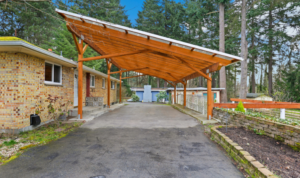
Common Carport Sizes at a Glance
| Carport Size | Square Feet | Common Use | Practical Notes |
| 10 x 20 carport | 200 sq. ft. | One compact or mid-size vehicle | Works for basic single-car coverage, but side clearance can be tight. |
| 20 x 10 carport | 200 sq. ft. | Same footprint as 10 x 20 | Useful when the lot is wider than it is deep, but orientation must be confirmed. |
| 14 x 20 carport | 280 sq. ft. | One vehicle with better side clearance | Better for SUVs, wider vehicles, and easier door opening. |
| 16 x 16 carport | 256 sq. ft. | Compact parking or utility coverage | Good for a short vehicle, trailer, mower, golf cart, or work zone. |
| 20 x 20 carport | 400 sq. ft. | Two smaller vehicles or one vehicle plus storage | A common double-car starting point, though large trucks may need more width. |
| 10 x 30 carport | 300 sq. ft. | Long vehicle, trailer, boat, or tandem parking | Helps with length, but the width remains tight for daily door clearance. |
| 40 x 20 carport | 800 sq. ft. | Multiple vehicles, equipment, or large storage | Needs careful planning for posts, drainage, anchoring, and permits. |
10 x 20 Carport: Best for One Standard Vehicle
The main benefit of a 10 x 20 carport is that it does not take up a large footprint. It can work well for a single daily driver, especially when the goal is basic shade and weather protection. It may also be a good fit for smaller homes where a larger carport would look out of scale.
However, the width can feel tight. Ten feet leaves room for the vehicle, but not much extra space to open doors wide, walk around both sides, or store items along the edge. If the vehicle is a midsize SUV, large pickup, or has wide mirrors, a 10 x 20 carport may protect the roof and hood but still leave the sides feeling close.
14 x 20 Carport: A More Comfortable Single-Car Option
A 14 x 20 carport gives a single vehicle more breathing room. Compared with a 10-foot-wide structure, the extra four feet can make daily use much easier. There is more space to open doors, walk around the car, carry groceries, or help kids in and out of car seats.
This size is often a better fit for larger SUVs, full-size sedans, and many pickup trucks. The 20-foot length still works for most passenger vehicles, while the wider layout makes the carport feel less cramped.
16 x 16 Carport: Square Coverage for Compact Spaces
A 16 x 16 carport is less common than 10 x 20 or 20 x 20, but it can work well for specific spaces. Because it is square, it gives generous width but shorter length. That makes it better for compact cars, motorcycles, small equipment, golf carts, or shaded utility space.
For a full-size vehicle, the 16-foot length may be too short. Many trucks, SUVs, and even some sedans can be longer than expected. If the vehicle sticks out past the roofline, the front or rear may still be exposed to sun and rain.
20 x 20 Carport: The Common Two-Car Choice
A 20 x 20 carport is one of the most popular two-car sizes. It provides homeowners with a square footprint that can accommodate two standard vehicles side by side. For families with two daily drivers, this size is often the first option they consider.
The main thing to understand is that 20 feet of width can be tight for two larger vehicles. Two pickup trucks or two wide SUVs may fit, but door clearance can be limited.
If both vehicles need to park side by side every day, the owner should check mirror width, door clearance, and the walking space required between vehicles.

10 x 30 Carport: Great for Long Vehicles, Boats, and Tandem Parking
A 10 x 30 carport is narrow but long. Instead of parking two vehicles side by side, it is often used for tandem parking, long vehicles, boats, or trailers. This size can work well on narrow lots where a wider two-car structure will not fit.
For example, a homeowner may use a 10 x 30 carport to park one vehicle behind another. It can also cover a long pickup truck, a boat on a trailer, a utility trailer, or a car with extra storage at the back. The long roofline gives more coverage than a 10 x 20 carport, especially for equipment that extends beyond standard vehicle length.
40 x 20 Carport: Large Coverage for Multiple Vehicles and Equipment
A 40 x 20 carport is a large structure that can cover multiple vehicles, work equipment, trailers, or a combination of parking and storage. It may be used for three or four vehicles, depending on how the space is arranged.
It can also be a good fit for homeowners who need a covered area for a boat, truck, mower, and outdoor equipment.
Because this size is much larger, planning becomes more important. The structure needs to fit the property, allow easy access, and still look appropriate with the home. A 40-foot-long roof can have a big visual impact, especially from the street.
How Much Extra Space Should You Plan Around the Vehicle?
One of the biggest mistakes homeowners make is choosing a carport based only on vehicle length and width. The vehicle may fit on paper, but daily use requires extra room.
A comfortable carport should give space for:
- Opening doors
- Walking around the vehicle
- Loading groceries
- Accessing truck beds
- Moving trash bins
- Storing bikes or tools
- Avoiding post contact
Final Thoughts
Carport sizes explained should make the decision easier, not more confusing. A 10 x 20 carport may be right for a simple single-car setup. A 14 x 20 carport offers more space for daily use, while a 20 x 20 carport can accommodate two vehicles.
The best size is the one that fits the property, protects what matters, and feels easy to use every day. That means measuring carefully, thinking about future needs, and choosing a structure that works with the home’s layout.
For homeowners planning a carport, patio cover, roofing project, or outdoor addition, All Good Roofing and Additions can help bring practical building experience into the design conversation.